
If you are asking which major celestial events will define 2026 — including planetary alignment, planet parade moments, eclipses and meteor peaks — here is the clear answer: the year will feature Jupiter and Saturn at opposition, a six-planet parade in February, a total lunar eclipse in March, a total solar eclipse in August, multiple major meteor showers and the closest supermoon of the year in December. These planetary alignments and sky events are predictable, time-bound and worth planning for in advance.
2026 follows a year of rare astronomical highlights. Yet the coming year stands strong on its own. From bright outer planets to rare eclipse paths across Europe and parts of Russia, the calendar offers structured, observable milestones for both casual viewers and serious skywatchers.
January 10: Jupiter at Opposition
The year begins with a classic planetary alignment event — Jupiter at opposition. Opposition occurs when Earth sits directly between the Sun and an outer planet. In practical terms, this means Jupiter appears fully illuminated, larger and brighter than at any other time.
This configuration happens roughly every 13 months. On January 10, Jupiter will rise at sunset and remain visible nearly all night. Observers can locate it near Castor and Pollux in Gemini.
Through binoculars, the four Galilean moons become visible. A small telescope may reveal cloud bands and even the Great Red Spot. Such opposition periods are also valuable for astronomers tracking minor asteroids, as brightness improves detection conditions.
Saturn will reach opposition later in the year, on October 4, offering a similar optimal viewing window for the ringed planet.
Late February: Six-Planet Planet Parade
In late February, a visible planet parade will draw attention. Mercury, Venus, Saturn, Jupiter, Uranus and Neptune will appear grouped on the same side of the sky.

From Earth’s perspective, all planets orbit along the ecliptic plane. When several cluster on one side of the Sun, we observe what is commonly called a parade of planets. While not rare in strict astronomical terms, such planetary alignments provide striking visual geometry.
Saturn, Venus and Mercury will form a tight grouping in the southern sky. Jupiter will shine brightly nearby. Uranus and Neptune, however, require optical aid.
A full seven-planet alignment — when all planets become visible at once — will not occur until February 3, 2034. Smaller groupings remain more common.
NASA has noted that these planet parade events are not once-in-a-lifetime occurrences, but they offer perspective: multiple worlds aligned in one sweep of vision.
March 3: Total Lunar Eclipse
In early March, a total lunar eclipse will occur. During this planetary alignment of Sun, Earth and Moon, Earth’s shadow fully covers the lunar surface.
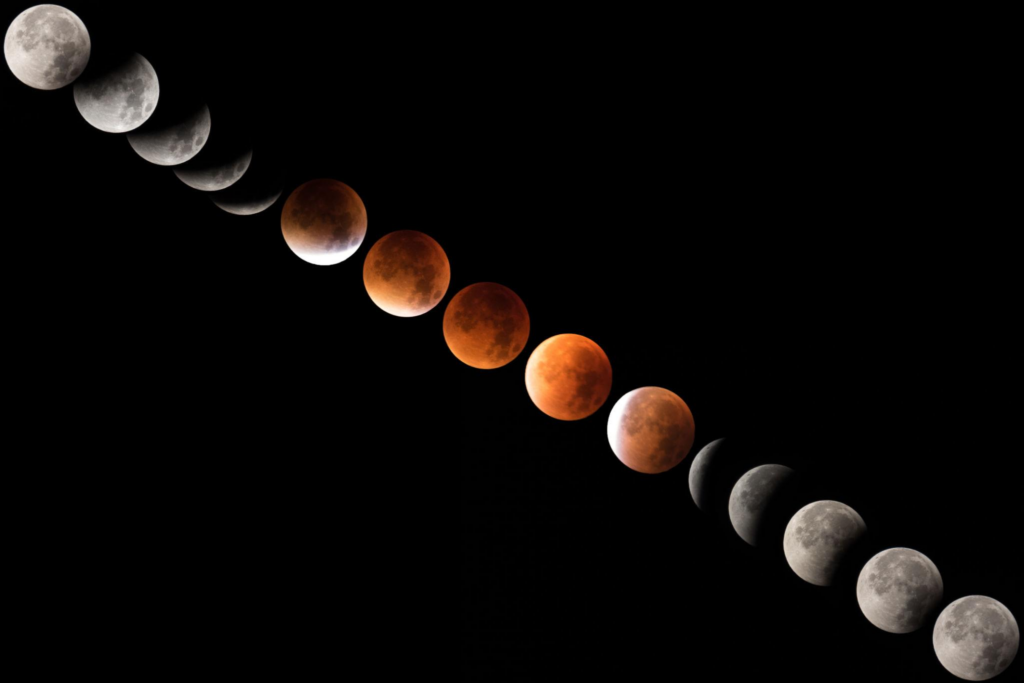
Because sunlight filters through Earth’s atmosphere before reaching the Moon, blue wavelengths scatter away. Red wavelengths dominate, giving the Moon a rust-colored glow — commonly called a blood moon.
Totality will last approximately 58 minutes. The full eclipse sequence will exceed five hours. In parts of North America, the Moon will set while still eclipsed.
Only about 29 percent of lunar eclipses are total. The next comparable total event visible in many regions will occur at the turn of 2028 to 2029.
April 21–22: Lyrid Meteor Shower
The Lyrid meteor shower will peak on the night of April 21–22. Under dark skies, observers may see up to 18 meteors per hour.
These meteors originate from debris left by Comet Thatcher, which has a 415-year orbit. As Earth crosses this debris stream, friction ignites small particles in the atmosphere.
The meteors appear to radiate from the constellation Lyra, near the bright star Vega. The best viewing window comes after midnight and before dawn.
Avoid artificial light. Allow about 15 minutes for your eyes to adapt. Meteor observation requires patience more than equipment.
May 31: Blue Micromoon
The full Moon on May 31 is both a blue moon and a micromoon.
A blue moon refers to the second full Moon within a single calendar month. This occurs because the lunar cycle of about 29.5 days does not align perfectly with calendar months. Such events occur roughly seven times every 19 years.
A micromoon occurs when the full Moon coincides with apogee — the farthest point in its orbit from Earth. On May 31, the Moon will be about 252,360 miles away, appearing slightly smaller and dimmer.
In 2026, three micromoons will occur — May 1, May 31 and June 29 — but the May 31 event will be the most distant.
August 12: Total Solar Eclipse
The most significant celestial event of 2026 will be the total solar eclipse on August 12.
During this planetary alignment, the Moon passes directly between Earth and the Sun. Because the Sun is roughly 400 times larger than the Moon but also 400 times farther away, they appear the same size in the sky. This geometric coincidence allows complete solar coverage.
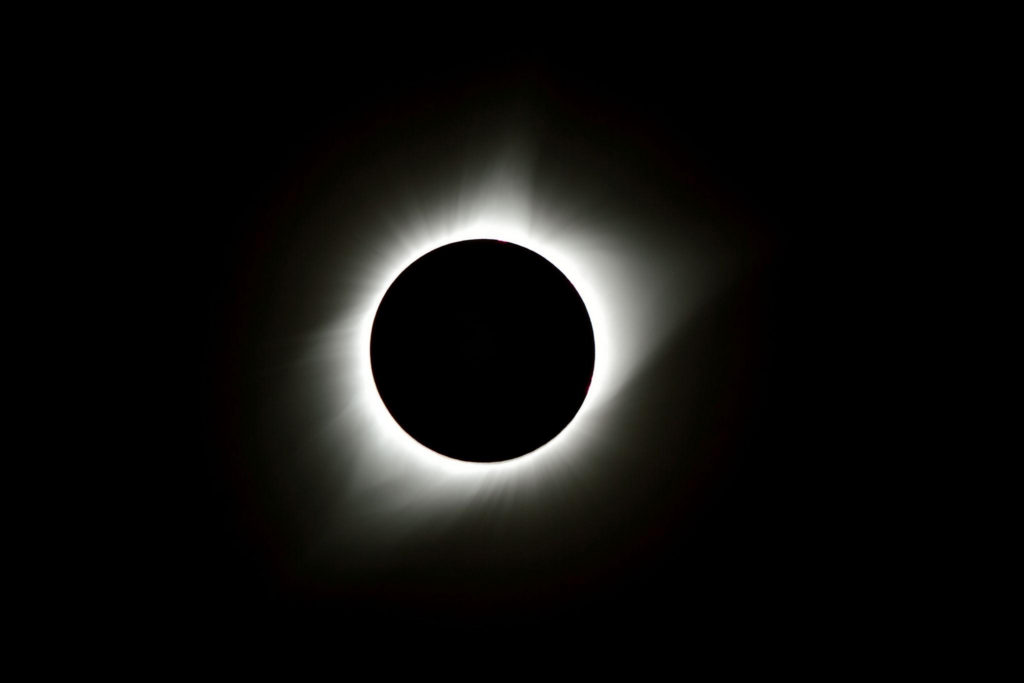
The path of totality will cross parts of Russia, Greenland, Iceland, Portugal and Spain. Much of Europe will witness near-total coverage. Partial phases will extend into parts of Africa, Asia and North America.
During totality, skies darken to twilight conditions. Stars become visible. The Sun’s corona — its outer atmosphere — appears as a glowing halo.
Eye protection is mandatory during all partial phases. Only during full totality can eclipse glasses be removed safely.
August 12–13: Perseid Meteor Shower
Within hours of the eclipse, the Perseid meteor shower will peak.
This year’s conditions are favorable because the shower coincides with a new Moon, reducing light interference. Under dark skies, rates may approach 100 meteors per hour.
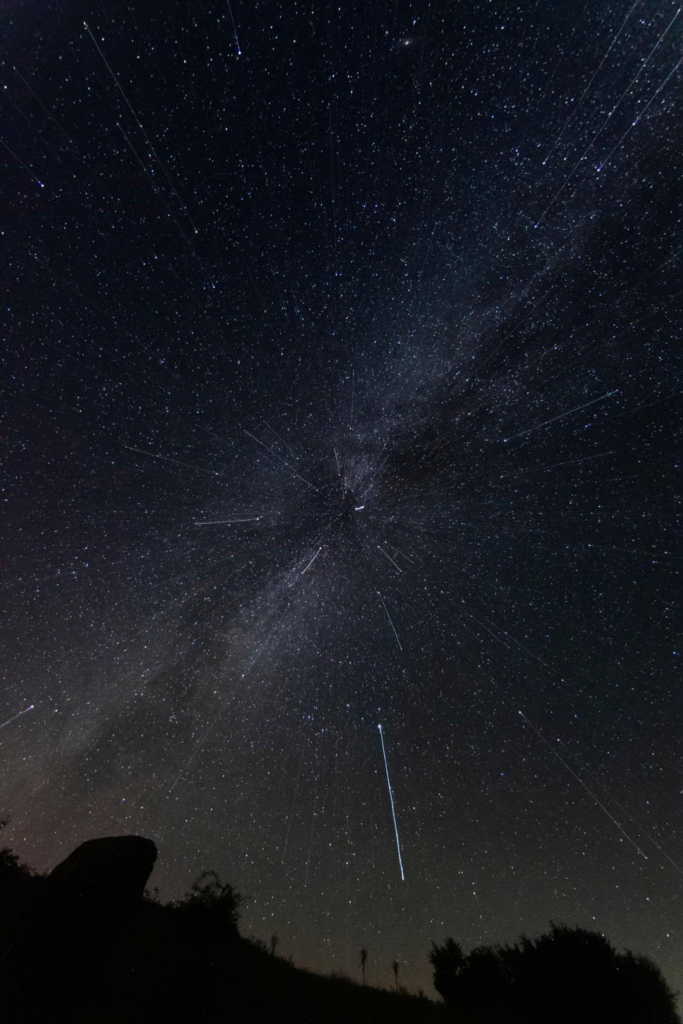
The Perseids originate from Comet 109P/Swift-Tuttle. Their meteors are bright and often leave persistent trails.
The best viewing times are the early mornings of August 12 and 13. This pairing of eclipse and meteor peak makes mid-August one of the strongest skywatching windows of the year.
September 18: Venus at Peak Evening Brightness
Venus will reach peak brightness in the evening sky on September 18.
Unlike the Moon, Venus appears brightest when in a crescent phase. When Venus is “full,” it is farther from Earth. As a crescent, it is closer and therefore more luminous.
Venus orbits between Earth and the Sun. As a result, it is visible only in morning or evening skies — hence the names “morning star” and “evening star.”
Later in the year, on November 27, Venus will reach peak brightness again — this time in the morning sky.
Autumn and Winter Meteor Cycle

The final quarter of 2026 brings a succession of meteor showers.
The Orionids peak October 21–22, producing up to 20 meteors per hour. These originate from Halley’s Comet debris.
The Leonids peak November 16–17, averaging about 15 meteors per hour.
The Geminids peak in December and are widely regarded as the most reliable shower. Under dark skies, rates may reach 150 meteors per hour. Unlike most showers, the Geminids originate from asteroid-like object 3200 Phaethon rather than a comet.
Major 2026 Sky Events at a Glance
Event | Date | Peak Visibility | Notes
Jupiter Opposition | Jan 10 | All night | Brightest view of Jupiter
Six-Planet Parade | Late Feb | Evening | Partial planetary alignment
Total Lunar Eclipse | Mar 3 | 58 min totality | Blood moon effect
Total Solar Eclipse | Aug 12 | Europe focus | Path of totality limited
Perseid Meteor Shower | Aug 12–13 | 100/hr | Minimal moonlight
Closest Supermoon | Dec 23 | Evening | Brightest full moon
December 23: Closest Supermoon
The year concludes with the closest supermoon of 2026 on December 23.
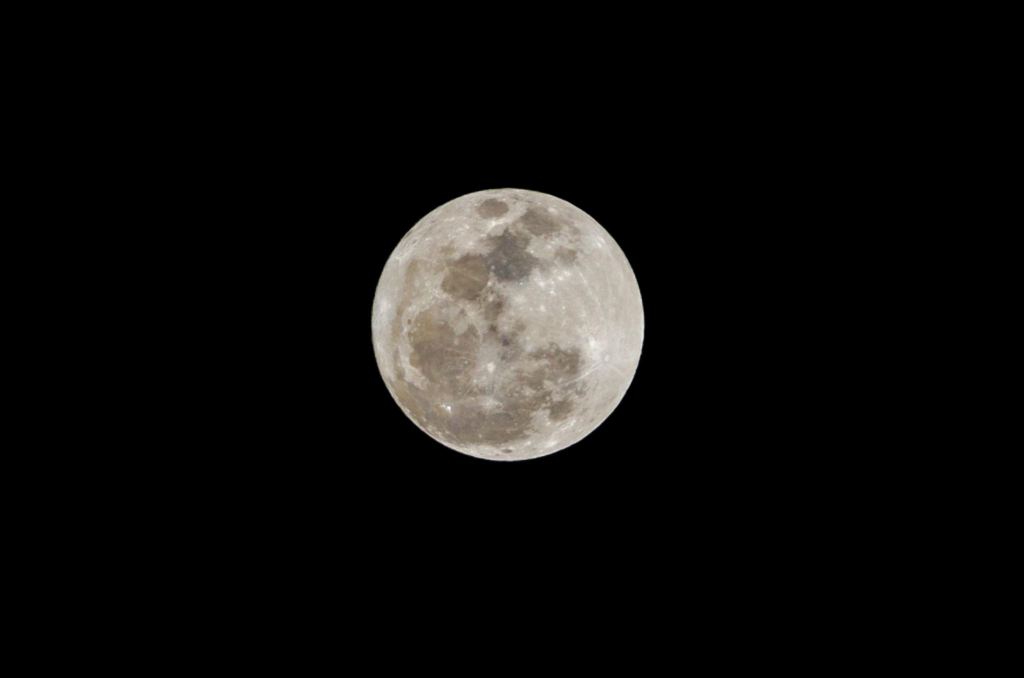
A supermoon occurs when a full Moon coincides with perigee — its closest orbital point to Earth. Compared to a micromoon, it appears about 14 percent larger and 30 percent brighter.
Peak brightness occurs at 8:29 p.m. Eastern Time, though the Moon will appear full for about three nights.
After a year of planetary alignments, planet parade moments, eclipses and meteor surges, this final lunar event offers a simple visual close to an active astronomical year.
Final Observation
2026 will not depend on a single dramatic event. Instead, it presents a structured sequence of observable milestones: opposition cycles, partial and total planetary alignments, meteor peaks and rare eclipse geometry.
For observers in India and globally, preparation is straightforward:
- Track precise local timings
- Choose dark-sky locations
- Use optical aids when required
- Follow safety protocols during solar viewing
The sky in 2026 will reward planning. Mark the dates. Adjust your schedule. Look up.